Examination
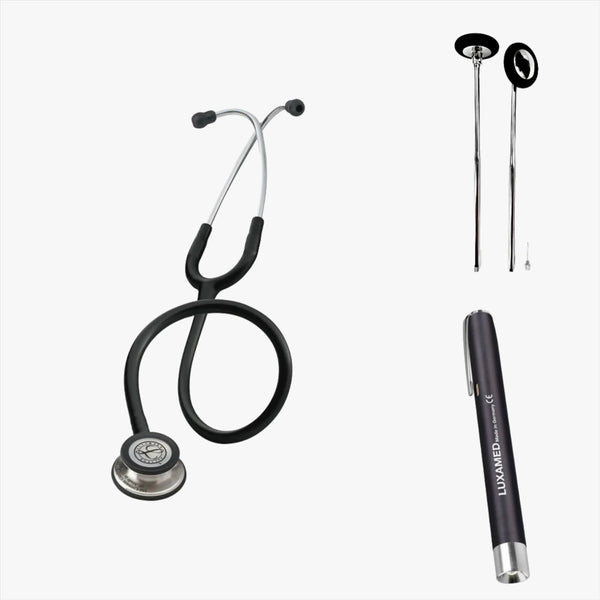
A Littmann stethoscope, a manual blood pressure monitor and basic examination instruments cover most of a clinical assessment in outpatient care, ambulance and field.
Stethoscopes, blood pressure monitors and examination instruments for everyday clinical work — not for home use. Littmann in every model, manual manometers, pulse oximeters and surgical instruments, chosen by anaesthetists and CPR instructors who use the equipment themselves.
Examination — alla produkter

Alla 50 produkter visas
Vanliga frågor om examination
Which Littmann stethoscope should I choose?
Classic III is the standard choice for general clinical auscultation and is enough for most examinations. Cardiology IV and Master Cardiology give higher acoustic performance and suit cardiology or lung sounds that are hard to interpret. CORE Digital adds electronic sound amplification for noisy environments. For children and newborns, Classic II Pediatric or Infant with a smaller chestpiece is used.
Manual or digital blood pressure monitor for clinical work?
Manual measurement with an aneroid manometer gives control through auscultation and is standard where the result has to be verifiable. Automatic monitors are faster when screening many patients but can be less reliable with an irregular heart rhythm. Many organisations have both: manual for assessment, automatic for routine checks.
How do you remove a tick safely?
Use pointed tick forceps and grip as close to the skin as possible, preferably around the tick's head rather than its body. Pull straight out with even pressure without twisting or squeezing the body, which can increase the risk of spreading infection. Clean the bite site afterwards and keep an eye on any redness of the skin over the following weeks.
What affects a pulse oximeter's reading?
A cold hand, poor peripheral circulation, nail varnish and vigorous movement all give unreliable SpO2 values. A professional fingertip pulse oximeter is normally more robust with a weak pulse signal than a simpler home model. The perfusion index, which shows the signal strength, is a good way to judge how reliable the reading is at that moment.
Do surgical instruments need sterilising between patients?
Reusable instruments such as haemostats, needle holders and surgical scissors must be cleaned and sterilised according to your hygiene routines before they are used on the next patient. The products are not supplied sterile for single use unless otherwise stated. Ask us if you need to combine them with single-use instruments for field or ambulance work.
Guider för Examination
Jämförelser av utrustningen i den här kategorin, skrivna av våra anestesiologer.

Medicinsk utrustning — guide av anestesiologer
Skrivet av Hjärtgruppens redaktion — anestesiologer och instruktörer inom prehospital akutsjukvård. Senast uppdaterad februari 2026. Rätt medicinsk utrustning kan avgöra utgången i en akut...

Vi hjälper dig välja rätt stetoskop!
Stetoskopet kan vara det verktyg många associerar allra mest till vården och det med god anledning. Ett bra stetoskop kan hjälpa en avgöra om...