Immobilisation means limiting movement in an injured body part. For a suspected fracture, first aid focuses on supporting the body part, avoiding unnecessary movement and arranging medical assessment. Equipment can help, but the right action always depends on the situation and the user's training.
Address life-threatening conditions first
A visible or suspected fracture may attract all the attention, but first aid starts with immediate threats to life. Make the scene safe and check responsiveness, breathing and severe bleeding. Call the emergency services if the person is seriously unwell, unconscious, having breathing problems, bleeding heavily or unable to be moved safely.
After immediate threats have been addressed, support the injured part. Avoid unnecessary movement and let it rest in the least painful position. Do not attempt to straighten a deformed arm or leg. With an open fracture, cover the wound and control severe bleeding before placing support material around the injury.
What is immobilisation?
Immobilisation is an umbrella term, not the name of a particular product. Its purpose is to limit movement while the person is assessed, treated or moved. A simple sling and an advanced rescue stretcher both belong to this field, but solve very different problems.
Common product groups include:
- Splint: supports an arm, leg, wrist or finger.
- Sling: supports the arm with very little packed volume.
- Cervical collar: professional equipment requiring correct assessment, sizing and application.
- Spineboard and harness system: equipment for lifting, extrication and short transfers under trained protocols.
- Stretcher or carry sheet: moves a person and is not a substitute for a limb splint.
See all immobilisation equipment when the requirement covers several product groups.
Splints for different requirements
A mouldable splint is flexible in storage and shaped around a body part to provide support. The instructions for use and local protocol determine how it is applied and secured. When purchasing equipment, the main differences are length, packed format, padding, cleaning and whether the product is single use.
| Model type | Format | Main distinction |
|---|---|---|
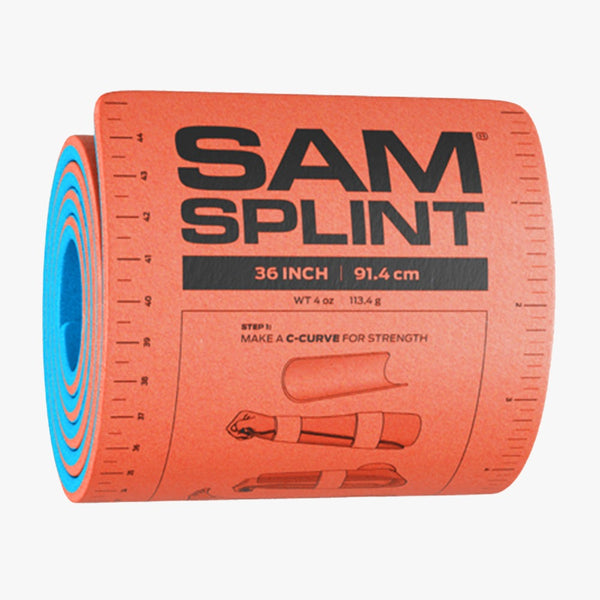
| SAM Splint 36-inch roll | 91 cm, rolled | Large mouldable area in a compact cylinder |
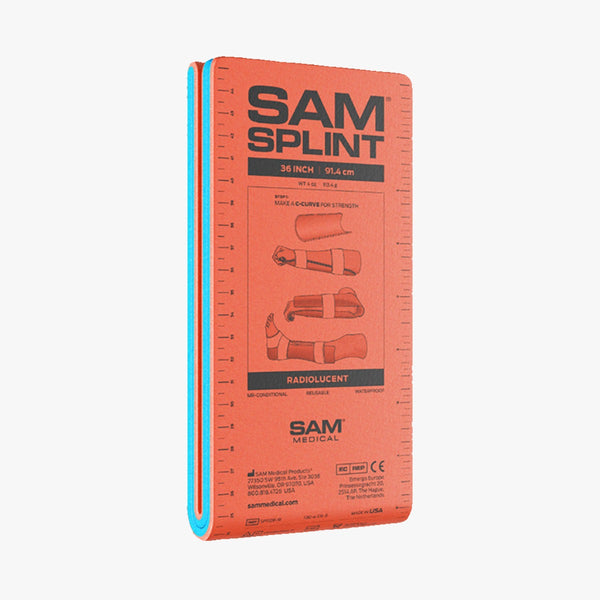
| SAM Splint 36-inch fold | 91 cm, folded | Same material in flatter storage |
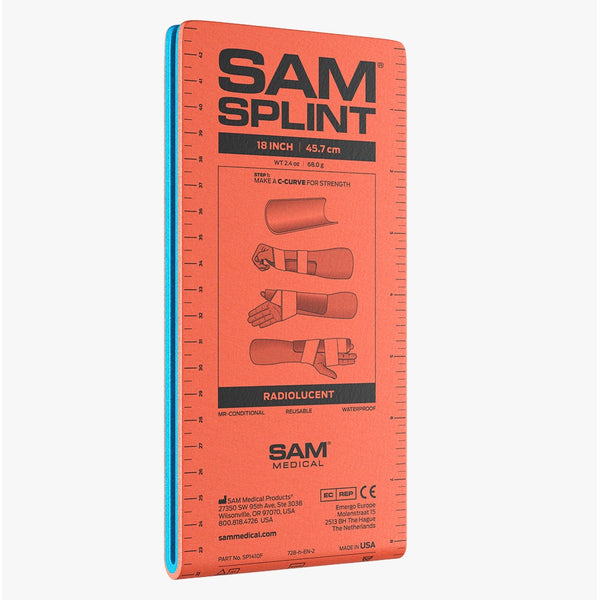
| SAM Splint 18 inch | 45 cm | Mid-size format for a more defined requirement |
| SAM Splint 9 inch | 23 cm | Short, compact model |
| SAM Finger Splint | approximately 10 cm | Smallest model in the range |
| SAM Sugar Tong Splint | Preformed U-shape | Designed to limit rotation around the forearm and wrist |
SAM Splint has a mouldable aluminium interior between two layers of closed-cell foam. It is flexible when flat, while a longitudinal curve gives it structural rigidity. The manufacturer describes the products as lightweight, radiolucent, cleanable and cuttable with ordinary scissors. The 36-inch model is available rolled or folded; shorter sizes are flat.
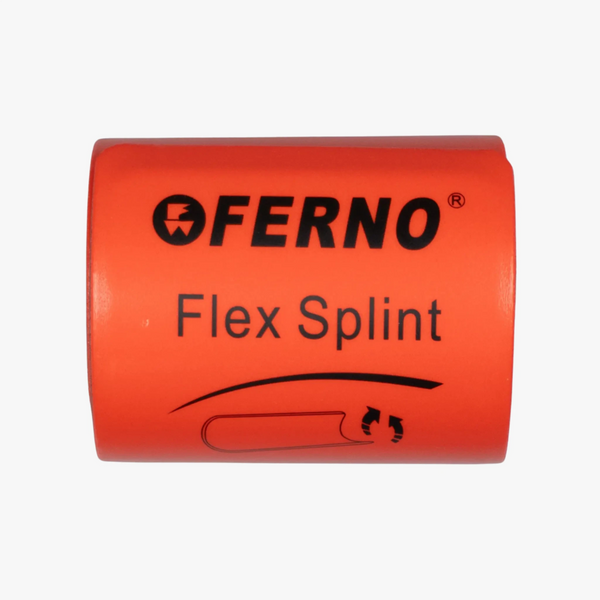
Ferno Flex Splint is another rolled, mouldable aluminium splint and is padded on both sides. FareTec Redi Splint combines an aluminium core with Volara foam. Dassiet UNO EMS is instead registered as a mouldable, single-use emergency splint and is supplied in a pack of three.
Choosing equipment for an organisation
Start with injuries that can reasonably occur, distance to professional help and the training staff actually have. A product that nobody has practised with does not automatically improve preparedness.
For an ordinary workplace or club, a mouldable splint, soft padding, elastic bandage and sling can cover several basic support requirements without taking up much space. Outdoor operations may prioritise low weight and a rolled 91 cm format. Ambulance, rescue and industrial response teams often need several sizes and separate equipment for movement and evacuation.
Cervical collars, spineboards and advanced harness systems should not be purchased simply to make a kit look complete. They require risk assessment, training, several helpers and a clear plan for care after the initial move. For help distinguishing core supplies from specialist equipment, request a quotation and advice.
Common mistakes
- The fracture is prioritised over a threat to life. Responsiveness, breathing and severe bleeding come first.
- The injured body part is moved unnecessarily. Support it in the least painful position and do not straighten a deformity.
- All splints are treated as identical. Length, packed format, padding and single-use status affect the need each model covers.
- Specialist equipment is purchased without training. A collar, spineboard or harness needs more than shelf space.
- Instructions and hygiene procedures are missing. Cleanable models and single-use products must be handled differently.
Sources and further reading
- Swedish Red Cross: first aid for fractures
- SAM Medical: SAM Splint models and product properties
- Ferno Norden: Flex Splint properties and cleaning